
The Billion-Dollar Solo Company Won't Come From AI
It'll come from plumbing. And almost nobody is building it.
Everyone posting about this is obsessed with the wrong layer. Better models, better reasoning, autonomous agents that "think." Meanwhile the actual bottleneck to running multiple companies has nothing to do with intelligence and everything to do with the fact that your AI forgets you exist every time you close the tab.
GPT-4 was smart enough two years ago. Claude was smart enough a year ago. The models aren't the problem. They never were.
The problem is that nobody built the memory.
It wasn't code quality. It was Tuesday.
I run seven companies as an active operator. Not advisory, not board seats. Shipping code, closing deals, running client calls, building infrastructure across seven different industries.
A Tuesday where I forgot a client's billing review, missed a follow-up deadline for another, had a compliance scope rotting in my inbox, and owed training to a fourth team I hadn't prepped for. All in my head. Scattered across WhatsApp, email, call transcripts, meeting notes. None of it in any system.
That's what breaks the solo operator. Not intelligence. Continuity.
The models can write your strategy doc, generate your compliance framework, draft your client emails. They've been able to do that for two years. What they can't do is remember that you told a client you'd revisit pricing on the 15th and that you haven't mentioned it since.
So I built a memory layer.
While everyone else was prompt engineering their way to a slightly better chatbot, I built a brain.
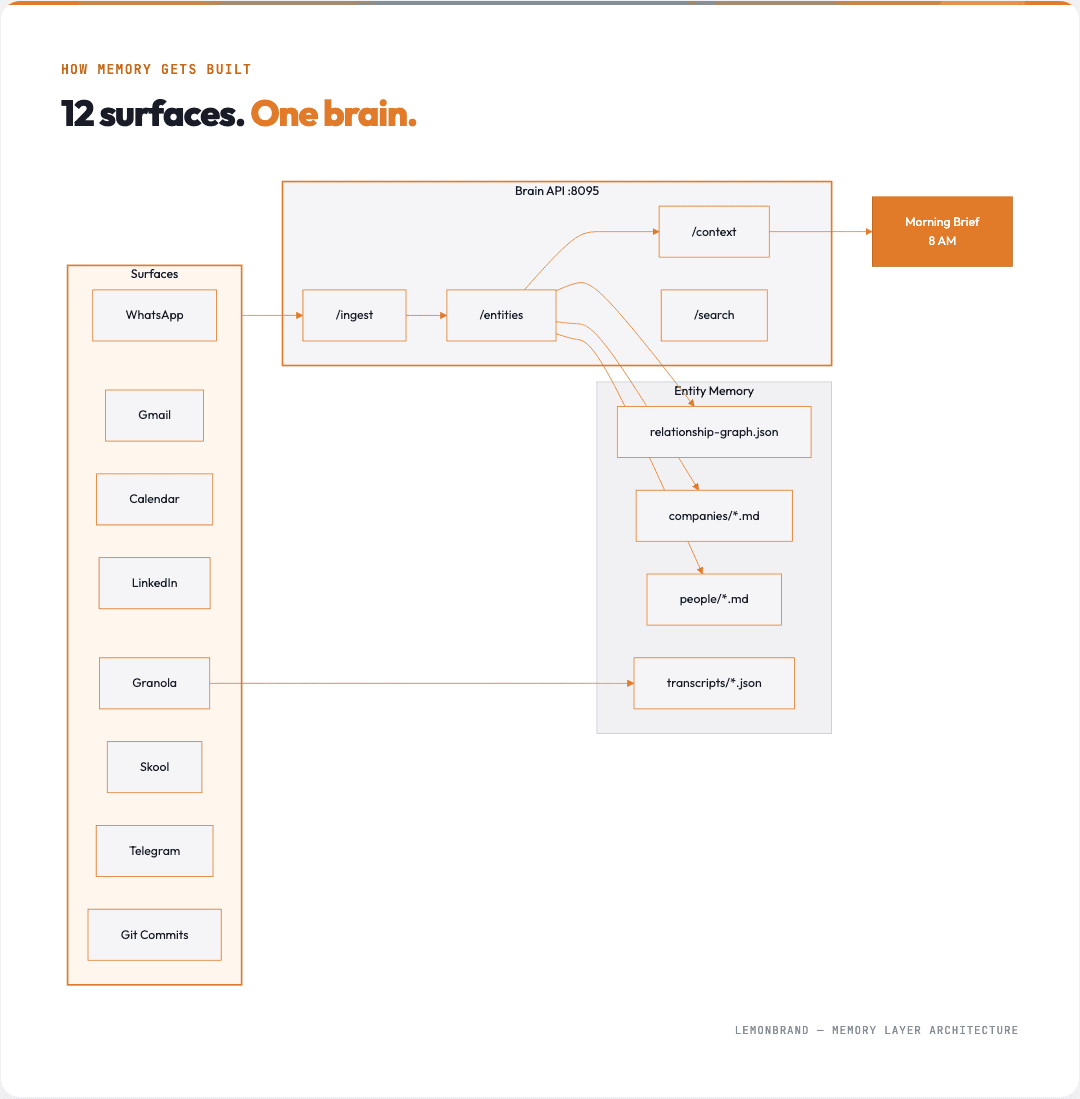
The system is a Rust service running on a VPS with SQLite storage, git-backed writes, and a REST interface. It doesn't use vector embeddings. It doesn't do semantic search over a blob of unstructured text. It builds a relationship graph: who said what, when, on which surface, and what's still open.
Eight surfaces feed into a single ingestion endpoint: WhatsApp, Gmail, Google Calendar, LinkedIn, Granola (meeting transcripts), Skool (community), Telegram, and git commits. Each interaction gets linked to the human who sent it, timestamped, and tagged with the surface it came from.
145+ entities. All connected.
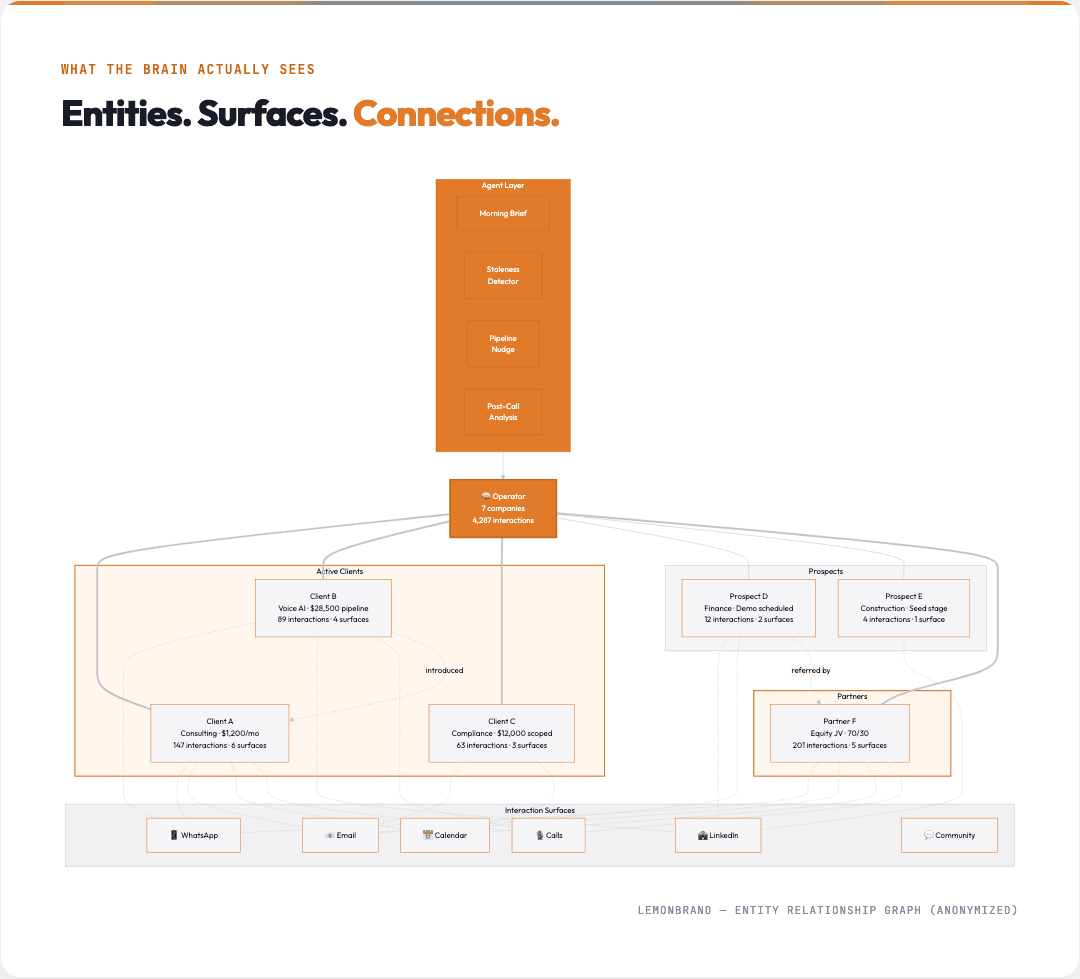
That's one entity. The brain tracks 145+ of them. Each with their own interaction history, surface distribution, relationship connections, and staleness state.
Every line is a real interaction on a real surface. The "introduced by" edges track how relationships formed. The agent layer watches everything and flags what needs attention. No entity exists in isolation. The system sees the web.
Your RAG pipeline doesn't do this. Your fine-tuned model doesn't do this. Your $50K "AI readiness assessment" from a consulting firm definitely doesn't do this.
The brief that replaces your brain.
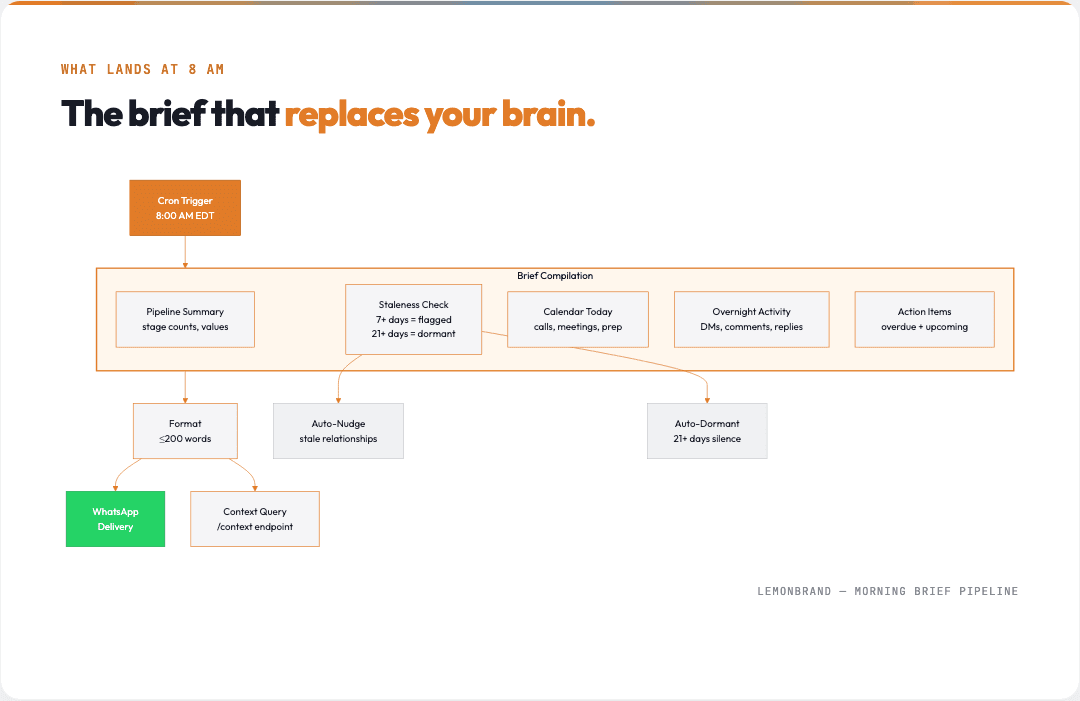
A cron trigger fires at 8:00 AM EDT. It compiles five data sources: pipeline summary, staleness checks, today's calendar, overnight activity, and overdue action items.
The output is a WhatsApp message, capped at 200 words. No fluff. Just: this is what matters, this is what you're about to forget, this is who went quiet.
The staleness logic matters most. If a relationship has had no interaction for 7+ days, it gets flagged. If it hits 21 days, the system auto-transitions the entity to dormant status. This isn't a reminder app. It's a relationship decay detector.
I didn't build a reminder system. The system watches every surface I operate on and tells me what I'm about to forget. A reminder system requires me to know what to remind myself about. The memory layer catches the things I didn't know I was dropping.
Day 1 vs. day 90. Same model.
Day 1, the agent follows instructions. It does what you ask, responds to what you type, generates what you prompt. It's a tool.
Day 30, it knows your clients by name. It tracks your pipeline by stage. It surfaces items you forgot about. It sends you a brief every morning without being asked. It's an assistant.
Day 90, it predicts churn from silence patterns. It spots revenue patterns across your portfolio. It flags relationship decay before you feel it. It operates proactively. It's an operator.
Same model. The only variable is accumulated context. The difference between a new hire and someone who's been at the company for a year isn't intelligence. It's pattern recognition built on thousands of small observations.
13 workflows died. Zero alerts. Three weeks.
13 workflows in my automation stack died silently. Zero alerts. Three weeks before I noticed. Three weeks where emails weren't being tracked, follow-ups weren't being flagged, and entity files weren't being updated.
The system was confidently telling me everything was fine because the part that checks whether everything is fine was also broken.
Memory without monitoring is just a liability with a delay on it.
This is the part the breathless "AI will replace everything" crowd never talks about. The failure modes. The silent rot. You don't just need the memory. You need health checks on the memory. You need monitoring on the monitoring. The infrastructure is boring and unglamorous and it's the only thing that makes any of this actually work.
The model is a commodity. The memory layer is the moat.
I'm not claiming I cracked the billion-dollar solo company. I don't know if I'll ever build a billion-dollar anything.
But I'll bet the person who does won't be using a better model than you. They'll have access to the same Claude, the same GPT, the same open-weight models as everyone else. The model is a commodity. It's already a commodity.
What they'll have is the plumbing. The memory layer that ingests every surface they operate on. The relationship graph that knows who said what and what's still open. The morning brief that tells them what matters before they've had coffee. The compound context that makes the same model produce fundamentally different output after 90 days than it did on day 1.
That's not a smarter AI. That's a system. And systems are built, not downloaded.
Get this in your inbox
Weekly deep-dives on the infrastructure behind running multiple companies with AI.
Subscribe on Substack