


Measurement and results

More capacity. Faster turnaround. Measured.

Baseline first, implementation second, the same measures after. This is the standard a result meets before it is published.Audit my inbox — free
Free60 minutesRead-only

Two measures carry the result.

Capacity

Work handled in a stated period, such as completed requests per week.

Turnaround

Elapsed time from the agreed start to the agreed end, both named up front.

Supporting measures that explain the result

Incoming and completed volumeWorking time and waiting timeTouches and handoffsException and rework volumeFirst response where it materially affects the workflowBacklog at defined pointsAdoption or route coverage where it is needed to read the result
Use the same definitions before and after implementation.
How we measure

A comparison is only readable when nothing moved underneath it.

Seven steps keep it comparable.THE MEASUREMENT CONTRACT
01Name the workflow and its owner.02Define the start, the completion, the capacity unit, and the period.03Record the baseline observation window and its data source.04Record the implementation and its release date.05Use a comparable post-change observation window.06Disclose material changes in volume, scope, staffing, seasonality, inputs, or service level.07Report measured values with units, limits, and exceptions.
If a definition changes, the comparison is restated, or it is explained why the periods cannot be compared.
Prompts, model calls, licences, logins, and tasks created are activity, not completed work.
The proof standard

What we will and will not claim.

A published result carries all of this

Real client context, approved for publication.One clearly bounded workflow.Baseline and post-change values from identified sources.The same capacity and turnaround definitions on both sides.An implementation description specific enough to understand what changed.Human ownership, review, approval, and exception controls.Comparable periods, or the differences stated in the open.Limitations and unresolved exceptions.

None of this is presented as a result

A projection or a modelled range.A sample report or a demonstration interface.An illustrative workflow written to teach a method.A pilot target or an internal goal.A quote from a client that carries no measured value.Activity counts from any AI tool.
LABELS USED ACROSS THE SITE

Measured result

A real before-and-after comparison. Never a forecast or an anecdote.

Client-reported result

Supplied by the client, with attribution and limits stated. Never presented as measured here.

Estimate

A documented projection made before measured evidence exists. Never a promised return.

Illustrative example

A fictional workflow that teaches a method or a boundary. Never client work.

Sample

A demonstration report or interface containing no real client evidence. Never a published result.

Client quote

A client-approved statement of experience. Any number in it passes the full standard, or goes.
Productivity, time savings, efficiency and speed are labels, not measures.
The standard comes before the stories

What is published here today.

This section changes when a client-approved case clears it.
No measured result from a client engagement is published here yet.When one is published, it will carry:
The client context and the approval to publish it.The bounded workflow, with its agreed start and completion.The baseline: capacity and turnaround, with units, periods, and sources.What was implemented, at which level, and on what date.The human controls: owner, approvals, exceptions, and escalation.The post-change comparison over a comparable period, with its limits.
ILLUSTRATIVE STRUCTURE: NOT A CLIENT RESULT

What a published result will look like.

Field names only. No values appear here, because no values exist yet.
WorkflowNamed operational workflow
Capacity unitCompleted items per stated period
Turnaround boundaryAgreed start event to agreed completion event
BaselineValue, unit, dates, and source
AfterValue, unit, dates, and source
Material differencesVolume, scope, staffing, seasonality, or input changes
Human controlsOwner, approvals, exceptions, escalation
Evidence labelMeasured result, client-reported result, estimate, illustrative example, or sample
The structure shows what to look for in any result, including one published by somebody else.

Common questions

An hours estimate rests on assumptions. Capacity and turnaround connect the change to output; time measures explain why it moved.

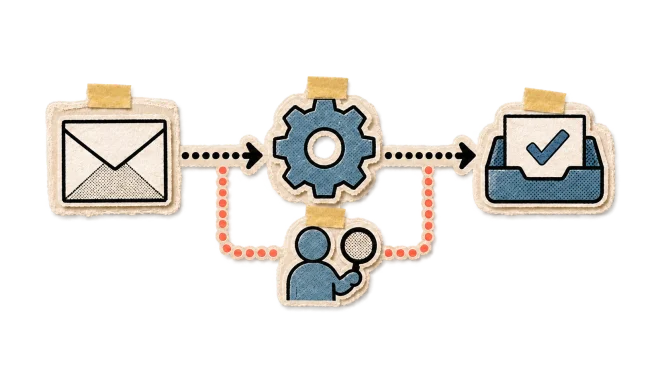
A request routed through automation with a person reviewing it before completion

Measure the work before you automate it.

A free inbox audit shows the first opportunities in one mailbox. Company-level proof needs team measurement.Audit my inbox — freeSee how the team audit works

Practitioners first

We use AI to run real work, every day.

We advise, build and operate. Our practice includes multiple dozen agents in production across growth, content, research, reporting and knowledge workflows. We bring that operating experience into our consulting, workshops and community teaching.

30 days of hands-on AI work · August 19–September 17, 2026

Projects with AI usage
38
Models used
13
Active days
30 / 30
Input tokens
308.6M
Output tokens
54.2M
Dashboard-reported cost
$14,271

Internal dashboard snapshot supplied September 17, 2026. These figures describe AI activity across our work during this period; project count and production-agent count are different measures.

What we actually run and build

From finding customers to getting work done.

01

GTM: from Apollo to Instantly

We run outbound workflows that source prospects through Apollo, write campaigns and send through Instantly. Our operating volume is thousands of emails per day. The work covers the path from finding prospects to campaign execution.


02

UGC and content production

We produce UGC content through Tonum. RV Management USA is an upcoming engagement. Our broader content work includes automated video uploads and social-media workflows.

03

Content awareness and competitive intelligence

We build agents that track content and competitors, organize findings and support in-depth reporting. They help turn ongoing information gathering into material people can use to make decisions.

04

Affiliate and knowledge-base agents

Our agent work includes affiliate marketing workflows and knowledge-base agents. These sit within our wider practice of multiple dozen production agents.

05

Full design systems and publishing workflows

We build complete design systems and automate parts of content publishing, including video uploads and social media. Design, content and engineering are part of the same delivery practice.

06

Consulting grounded in daily use

We help teams decide what to do with AI, then help implement it. Our consulting and thought leadership draw on the systems we operate, the work we publish and hands-on community learning, including Saturday AI Club in Ottawa.

Lemonbrand
OpenAI Select Partner

We take the work nobody owns and give it to a robot, then we stay.

SocialsYouTubeLinkedInInstagramSubstack
© Lemonbrand 2026